Finlay Andrews
Hide and SeekFinlay Andrews moves easily between respectable business, private clubs, and the hidden enterprise Rebus eventually identifies as Hyde’s Club. Introduced as a member of Superintendent Watson’s anti-drugs committee, he appears in public among the city’s businessmen; later, Rebus recognizes him as the proprietor behind an operation tied to Ronnie McGrath’s death. The contrast between those appearances gives Andrews’s character its defining shape: a figure of public respectability whose influence helps keep the darker business around him out of public view.
Identity and Public Standing
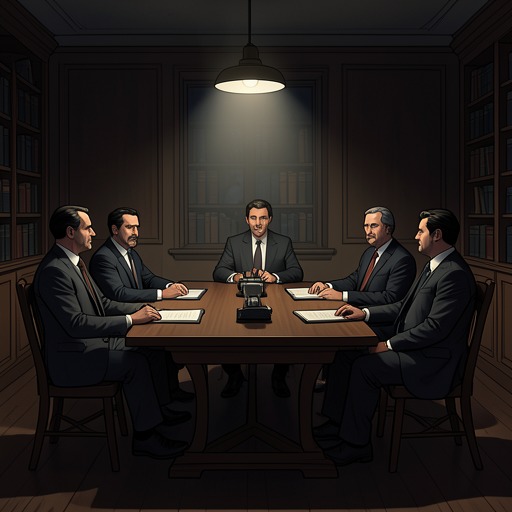
Andrews first appears at a luncheon arranged by Superintendent Watson, who is seeking businessmen’s backing for a public-awareness campaign and discreet information about Edinburgh’s drug problem. Watson introduces Andrews as a committee member and mentions his gaming establishment on Duke Terrace, Finlay’s Club. Andrews supplies the club’s name himself. Rebus reads his handshake as the prolonged, testing grip of a Freemason, placing him within a world of private recognition and connections, though the scene does not establish what specific influence those ties bring him.
The luncheon presents Andrews as both a businessman and a participant in civic respectability. He handles the wine order, choosing an aged claret and Chablis, and discusses planning permission with James Carew, of Bowyer Carew Estate Agents, about an extension to the casino. Andrews says the application appears to be going well. Tommy McCall responds by contrasting that smooth progress with what ordinary neighbors might expect for a large extension. The exchange hints at unequal access to favorable decisions, but it does not spell out how the permission was secured.
Andrews’s composure is not unbroken. When Tommy McCall raises the exclusion of Chinese gamblers from Finlay’s Club, Andrews says the management will not let the man back in. Later, as McCall starts to disclose where those players keep their money, Andrews gives him a hateful look; Superintendent Watson stops the conversation because they are eating. These small moments place Andrews among men alert to one another’s interests and resentments, while revealing little openly about the business beneath their polished gathering.
Connections and the Hidden Club
At the luncheon, Andrews is the link between the committee and Malcolm Lanyon, whom he introduces as an advocate and a member of the group’s working committee. Lanyon’s wealth and celebrity make him conspicuous, but the later discovery of Hyde’s Club gives their association a more consequential context. The hidden venue is associated with Andrews, Lanyon, and a clientele drawn from the city’s wealthy and influential circles. Its private entertainments and betting are far removed from the respectable committee work with which Andrews first enters the story.
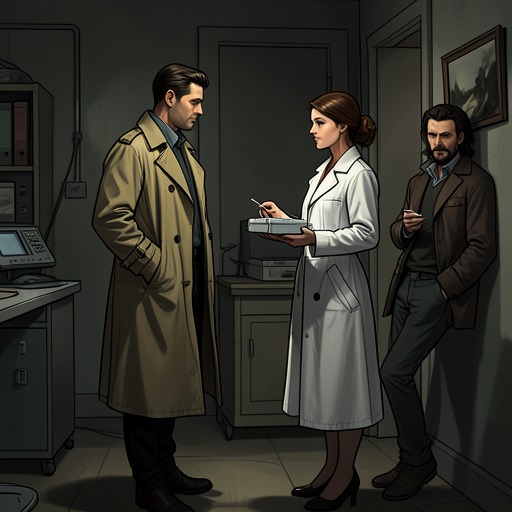
Rebus’s understanding of the club emerges by degrees. He finds a small boxing ring in a large room, along with chairs for spectators, and connects the place to rumors passed on by Calum McCallum. The evidence points beyond ordinary casino business to secret events held on the third Friday of the month and to private spaces used by clients. Rebus calls for Andrews inside the venue. The scene makes the contrast between the club’s hidden activities and its owners’ public standing physical: behind the respectable city’s doors lies an operation that depends on discretion and on people with enough power to preserve it.
Ronnie McGrath and the Investigation
Andrews’s gravest connection is to Ronnie McGrath’s death. Rebus reasons that Ronnie may have photographed wealthy and influential people at the club, either while working there or while secretly carrying a camera. The precise circumstances of the photography remain uncertain. What Rebus considers decisive is that Andrews learned Ronnie had hidden photographs—an insurance against what might happen to him—even though Rebus judges those pictures of little practical value as evidence or blackmail material.
Rebus’s reconstruction is that Andrews killed Ronnie after discovering the photographs’ existence, then arranged the scene to make the death look like a straightforward overdose and to divert attention with a ritual-looking tableau. The apparent occult clues had led Rebus to read too much into the scene; the larger explanation lies in the club and its feared exposure, not in the ritual meaning he initially assigned to the body’s position and surroundings. Andrews’s importance to the case is therefore not simply that he owns an illicit venue: in Rebus’s account, he acts to protect the larger operation when Ronnie’s concealed images seem to threaten it.
The investigation is obstructed by a separate attempt to frame John Rebus. Rebus calls the accusations a set-up, but Superintendent Watson insists that the allegation must be investigated and orders him to keep away for a time. This interruption gives the criminal enterprise room to hide behind official procedure, although the available account does not establish that Andrews personally arranged the frame. Later, Rebus remains officially excluded from the case but stays close to the questioning of Lanyon, wary that legal technicalities might let him escape accountability.
Exposure, Death, and Narrative Role
When Rebus confronts the operation, Lanyon speaks of a long-term future for him in Edinburgh’s commercial development and follows the offer with a threat of being buried in concrete. Andrews is named as Lanyon’s partner in that future. The exchange compresses the club’s governing logic: influence is offered as a route into the powerful circle, while violence is the answer to a witness who knows too much. Andrews is subsequently reported as dead. Rebus phones the hospital after the confrontation and learns that Andrews has been treated for an injury and lost little blood; the later public account reports his death without providing a fuller explanation of its circumstances.
The scandal that follows is quickly contained. Reports acknowledge that Andrews ran a club whose dealings were not entirely legitimate, while leaving the nature of its activities unspecified. Lanyon’s death is reported as suicide after the authorities began closing in, but the public story does not disclose the scale or character of the operation the investigation uncovered. Andrews thus becomes a figure in the book’s contrast between a respectable civic surface and concealed power: his role is central to Rebus’s explanation of Ronnie’s death, yet the official and journalistic aftermath leaves much of that explanation out of public view.